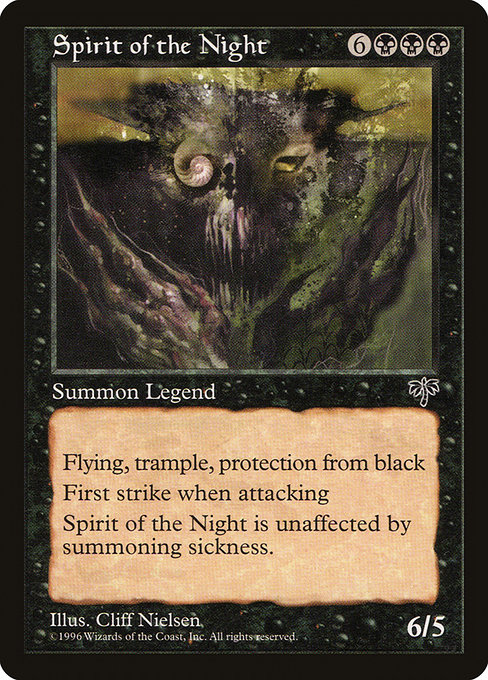
Image courtesy of Scryfall.com
Spirit of the Night: A Pillar of Long-Term Value in MTG Finance
In the grand tapestry of MTG history, few cards embody the era’s audacious design like Spirit of the Night. A legendary Demon Spirit from Mirage, this heavy-hitting mythic-era finisher sits at a staggering mana cost of {6}{B}{B}{B} and a robust 6/5 body. Its color identity is pure black, and its presence on the battlefield is nothing short of theater: Flying, Trample, Haste, and Protection from Black all bundled into a single, threatening package. Add a curiously practical pal to the stack—first strike while attacking—and you’ve got a card that rewards aggressive play while complicating how opponents respond in black-centric metas 🧙♂️🔥.
From a finance vantage point, Spirit of the Night is a compelling case study in long-term value. It’s a Mirage rare on the reserved list, a status that fundamentally shapes its market ceiling. The Reserved List pledge—no reprint in the future—helps anchor scarcity even as the card remains playable in Legacy, Vintage, and especially Commander, where mono-black and multi-color builds frequently crave big, slam-dunk finishers. That durability matters in a world where formats wax and wane like a moonlit tide. While the card’s raw power makes it a credible tournament prospect in Legacy lines, its true financial gravity lies in evergreen demand from collectors and long-term players who value scarcity as a flavor with financial taste 🧪💎.
Artistically, Spirit of the Night channels that late-1990s ominous mood, with Cliff Nielsen’s art delivering an iconic silhouette of a demon-spirit surge. The Mirage frame—its own weight in MTG history—paired with a rare status, has helped this card maintain a steady grip on the minds of collectors who chase nostalgia as tenaciously as they chase mana. For those considering the long view, holding a copy in reasonable condition is not just about raw power on a table; it’s about owning a parcel of a bygone era that still resonates with the current game’s mechanics and lore 🖌️.
On the table, Spirit of the Night’s long-term value is tied to more than just being a big black beater. Its protection from black means it can slip past some of the era’s most vexing removal while still posing a threat that demands a coordinated answer. It’s not immune to everything—sweepers, prizing a mass answer, or a clever hand disruption can still tilt a game—but the card’s sheer presence creates tension that can outlast a single turn. When you pair this with its first-strike twist while attacking, you get a dynamic that encourages opponents to rethink blocking decisions and removal timing, turning every encounter into a strategic chess match 🎲⚔️.
From a finance lens, the card’s rarity and historical context matter more than any single deck’s success. Mirage was a landmark set that defined an era’s aesthetic and mechanical ambitions. Spirit of the Night’s status as a reserved-list rare adds a psychological premium: buyers anticipate that copies won’t infinitely re-enter circulation, creating a floor around a modest-to-solid value trajectory—one that isn’t as volatile as some modern staples. The current approximate market snapshot places it in a niche tier where collectors, vintage enthusiasts, and black-maction players find it compelling. Its scarcity isn’t a hype curve; it’s a sustainable recognition that certain cards belong to a closed club, and the club values that exclusivity 🔒🧭.
For investors and players alike, Mirage’s Spirit of the Night demonstrates why long-term MTG value isnibly matters. It’s not merely about a card’s power curve in a single modern format; it’s about the resonance of a card’s identity—its lore, its rarity, and its legacy. In the grand calculus of MTG finance, such pieces serve as anchors: not every card climbs, but those anchored to a reserved list and a storied art direction offer a plausible path to steady appreciation over years. And if you’re building a black-black tradewind deck or a nostalgic cube that favors iconic legends, this demon-spirit brings a narrative cohesion that goes beyond numbers 🧙♂️💎.
Speaking of long-game play, the collection’s maintenance matters as much as the card’s fate in a single season. The Mirage era, with its distinctive art and bold card design, invites a certain kind of collector who cherishes both playability in enduring formats and the story of MTG’s evolution. Spirit of the Night isn’t simply a creature card; it’s a tie to a moment when MTG risked audacious power on the battlefield and in the courtroom of design decisions. That ambition is a meaningful through-line for financiers who want to see a card that remains relevant in older formats while continuing to haunt casual games with its sheer, unyielding presence 🎨🧙♂️.
For players curious about practical deck-building considerations, consider that Spirit of the Night occupies a curious space—expensive to cast, but with the potential to close games abruptly when you can juice its stats and protect it long enough to swing in with menace. In Commander, it’s a classic “go big or go home” option; in Legacy, it’s a late-game threat that demands immediate removal or a strategic plan that hinges on answering an enormous problem piece. The price tag—around a modest range in today’s market—reflects not only its power but its cultural resonance in a game that values both storytelling and mechanical depth 🧙♂️🔥.
Non-slip Gaming Mouse PadMore from our network
- https://crypto-acolytes.xyz/blog/post/how-localization-shapes-global-mmo-success/
- https://blog.digital-vault.xyz/blog/post/evaluating-innovation-risk-in-yuki-onnas-mtg-card-design/
- https://transparent-paper.shop/blog/post/red-bp-rp-color-of-a-hot-halo-giant-at-17-kpc/
- https://crypto-acolytes.xyz/blog/post/love-in-pixels-in-game-marriages-and-virtual-relationships/
- https://blog.digital-vault.xyz/blog/post/why-anzrags-rampage-shapes-mtg-canon/