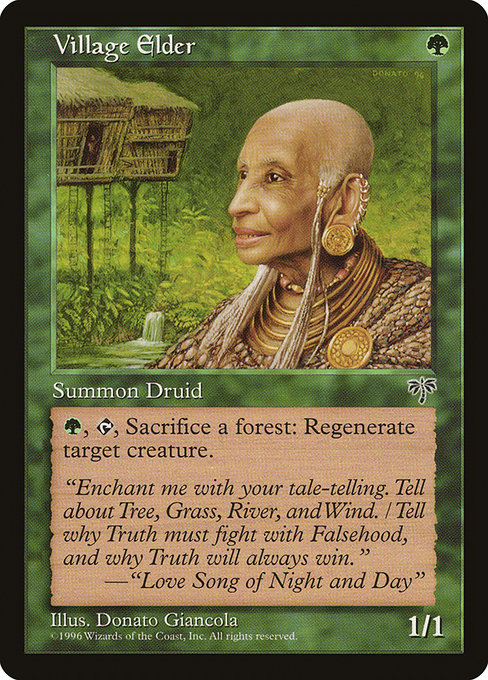
Image courtesy of Scryfall.com
Village Elder: A Green Stewardship Rooted in Mirage’s Forested Realms
If you’ve ever built a green-heavy deck around life-giving redundancy and resilience, you’ve likely felt the tug of Village Elder’s quiet philosophy. This one-mana green creature—a humble 1/1 Human Druid—embodies a core MTG instinct: protect what you’ve cultivated, even if it means paying a small price. In Mirage’s lush world, the elder’s gesture—{G}, tap, and sacrifice a Forest to regenerate a creature—reads like a parable: nurture your grove, and the grove will nurture you back. 🧙♂️🔥
The card’s mechanical centerpiece is elegant in its simplicity. For a single green mana, you summon a protective voice for your side of the board. The requirement to sacrifice a Forest ties the elder to the land itself—green’s most fundamental resource—and asks you to invest in the forest you’re protecting. This is more than a mana-cost calculation; it’s a thematic contract: you don’t get something for nothing. In the old-school Mirage environment, where the board could swing on a dime, Village Elder offered a reliable, evergreen answer to aggression, while staying true to green’s identity as guardian and regenerator. 💎⚔️
“Enchant me with your tale-telling. Tell about Tree, Grass, River, and Wind. Tell why Truth must fight with Falsehood, and why Truth will always win.”
That flavor text isn’t just a garnish. It crystallizes Village Elder’s canonical aura: a storyteller of the forest who upholds truth through living nature. In a game that often frames conflict in terms of spells and budgets, this elder grounds the drama in a moral ecology. The line bridges narrative and mechanic—every time you sacrifice a Forest to activate regeneration, you’re participating in the forest’s ongoing story of survival, balance, and stewardship. In Mirage’s lush terrain, elders aren’t distant sages; they’re neighbors who defend the green world by practical, often sacrificial means. 🎨🧭
Design, Flavor, and the Blueprints of Green Identity
Village Elder is a study in compact MTG design. A 1/1 body for {G} is not flashy; it’s deliberately modest, because the effect is where the card shines. Regeneration—then a robust, old-school mechanic—was long a green staple, allowing a creature to survive lethal damage or wiped board states by tapping into the cycle of life within your forests. The cost—sacrifice a Forest—creates a meaningful decision: you must consider what you’re willing to lose to save whom you care about on the battlefield. This is green philosophy in practice: sacrifice today to protect tomorrow’s life forces. And when you’re playing a long, grindy green deck, Village Elder often pays for itself several times over as you stabilize the table. 🧙♂️💚
From a historical vantage point, Mirage introduced many players to a world where forests aren’t just backdrops but active participants in the game’s gambits. Village Elder’s presence—tied to the land and to the ritual act of regeneration—helps codify the setting’s green-aligned ethos. Donato Giancola’s art reinforces this vibe with a dignified, weathered elder who exudes quiet authority, a living reminder that in the forest, wisdom is as vital as raw power. The card’s rarity, common, mirrors the archetype’s role as a staple of early green strategies—a reliable, everyday tool rather than a flashy gimmick. 🔥🎲
Canon, Lore, and Practical Play in the Modern Era
In the larger MTG canon, Village Elder represents a recurring theme: the forest as a community guardian that values continuity and protection over brute force. The ability to pay {G} and tap to protect a creature aligns with green’s broader habit of ensuring resilience—whether that means saving a blocker, protecting a commander, or staving off a sweep long enough for other pieces to come online. While the lore around individual cards from Mirage is often light, the shared thread is unmistakable: elders nurture and shield, not merely rule. This makes Village Elder a favorite for players who savor tribal stories, forest-themed decks, or nostalgia trips to early green’s design language. 📜🌿
From a deckbuilding perspective, Village Elder shines in creature-heavy strategies that lean on regeneration to weather damage, with or without the presence of other forest-themed synergies. It’s not a card that will single-handedly win a game, but it can anchor a midrange board state, enabling a stalemate where you outlast rivals while you assemble your longer-term plan. In EDH/Commander circles, the elder often becomes a thematic centerpiece of green-tribal or forest-valor archetypes, where a cadre of forest guardians can turn a fragile board into a persistent fortress. The flavor of the story remains intact: a village elder who uses the forest’s lifeblood to safeguard life itself. 🧩🛡️
From Mirage to the Meta: Why Village Elder Still Resonates
Although Village Elder isn’t a modern staple in the metagame, its relevance endures for fans who love the line between nature and nurture. The card invites players to reflect on the value of restraint and reciprocity in a fast-paced, power-pump era. Its spirit—protective, patient, and deeply connected to the land—continues to echo in new green iterations, reminding us that some of the strongest play in MTG comes from knowing when to invest in the forest’s future. And yes, the art still turns heads during a casual Friday night; it’s a reminder that the game’s old-school moments carry a timeless, almost pastoral charm—like a campfire tale told under a canopy of ancient trees. 🎨🪵
As you consider building around Village Elder or simply revisiting Mirage-era flavor, let the card’s simple mechanics guide your appreciation: a single green mana unlocking a shield for your creatures, earned through a small but meaningful sacrifice. It’s a poetic reminder that in MTG’s grand canon, true power often lies in stewardship as much as in spark and fury. ⚡🌲
Phone Grip Click-On Universal KickstandMore from our network
- https://wiki.digital-vault.xyz/wiki/post/pokemon-tcg-stats-pikachu-card-id-bw4-39/
- https://wiki.digital-vault.xyz/wiki/post/pokemon-tcg-stats-palafin-card-id-svp-036/
- https://crypto-acolytes.xyz/blog/post/nft-stats-pill-money-podz-880-from-pill-money-podz-collection/
- https://blog.rusty-articles.xyz/blog/post/magenta-wool-flooring-ideas-for-minecraft-builders/
- https://crypto-acolytes.xyz/blog/post/nft-stats-haste-core-a891-from-haste-core-collection/
Village Elder
{G}, {T}, Sacrifice a Forest: Regenerate target creature.
ID: 253a1d97-ec45-41c9-ba81-bbb6ab584b2b
Oracle ID: adea6cb4-1e74-4137-9c80-1dde004a6b26
Multiverse IDs: 3420
TCGPlayer ID: 5284
Cardmarket ID: 8200
Colors: G
Color Identity: G
Keywords:
Rarity: Common
Released: 1996-10-08
Artist: Donato Giancola
Frame: 1997
Border: black
EDHRec Rank: 22824
Set: Mirage (mir)
Collector #: 251
Legalities
- Standard — not_legal
- Future — not_legal
- Historic — not_legal
- Timeless — not_legal
- Gladiator — not_legal
- Pioneer — not_legal
- Modern — not_legal
- Legacy — legal
- Pauper — legal
- Vintage — legal
- Penny — legal
- Commander — legal
- Oathbreaker — legal
- Standardbrawl — not_legal
- Brawl — not_legal
- Alchemy — not_legal
- Paupercommander — legal
- Duel — legal
- Oldschool — not_legal
- Premodern — legal
- Predh — legal
Prices
- USD: 0.14
- EUR: 0.04
- TIX: 0.05
More from our network
- https://crypto-acolytes.xyz/blog/post/trading-the-news-how-crypto-regulations-move-markets/
- https://wiki.digital-vault.xyz/wiki/post/pokemon-tcg-stats-meloetta-card-id-xyp-xy193/
- https://blog.crypto-articles.xyz/blog/post/nft-data-gold-bar-491-from-solana-gold-bars-collection-on-magiceden/
- https://transparent-paper.shop/blog/post/create-stunning-seasonal-invitation-templates-in-minutes/
- https://zircon-images.zero-static.xyz/c130c58c.html